2022年4月7日 星期四

Guanxi and Moral Articulation:Strategies of Corruption During China’s Anti-Corruption Drive

主講人:呂青湖(國立臺灣大學社會學系副教授)

主持人:劉紹華(中央研究院民族學研究所研究員)

主辦單位:中央研究院民族學研究所「世界化中國研究群」

時間:2022422日(五)15:00-17:00

地點:中研院民族所新館三樓第三會議室R2319(本場次為實體演講)

報名網址:https://forms.gle/QDaL9H3ZGFfrXHZ76

報名截止日期:4/17(日)止(因會議室有人數限制,報名截止後將寄送報名成功信)

*本場次為實體演講,中英文同時進行

會議聯絡Emailgcstudies@gate.sinica.edu.tw

摘要:

What explains failures of large-scale anti-corruption campaigns in reducing corruption? Theories on developing country corruption see corruption as either a problem of weak formal institutions that incentivize naturally opportunistic actors or as remnants of traditional behaviors that persist despite changing modern state boundaries and regulations. Neither helps explain how participants continuously strategize to reframe and articulate the morality of those questionable transactions.

    This paper, through multi-year fieldwork and 34 interviews with business elites in China’s Guangdong province, examines how officials and businesses reconfigured their strategies of corruption during a recent anti-corruption campaign. We find that key actors engaged in ‘moral articulation’ – devising moral repertoires and realigning common exchange practices to accepted meaning frames to safeguard interests and obfuscate their activities. In doing so, they challenged some aspects of state-initiated definitions of corruption while embracing others. Rather than eliciting conformity, the campaign prompted new ingenious action frames that helped internally justify corruption and allowed questionable exchange practices to continue on.


2022年2月28日 星期一

文革基督教的物質實踐與文化連續性問題

主講人:高晨揚 (中央研究院民族學研究所副研究員)

主持人:劉紹華 (中央研究院民族學研究所研究員)

主辦單位:中央研究院民族學研究所「世界化中國研究群」

時間:2022311日(五)15:00-17:00

地點:中研院民族所新館三樓第三會議室R2319(本場次為實體演講)

報名網址:https://forms.gle/joV3PsozEDY2bs9e7

報名截止日期:3/8(二)止(因會議室有人數限制,報名截止後將寄送報名成功信)

會議聯絡Emailgcstudies@gate.sinica.edu.tw

摘要:

中國基督新教於文革中期復甦。本次演講探討文革時期「信耶穌」的人在沒有教堂、聖經或傳道人的情況下如何能辨識基督新教與漢人民間信仰的區別,以及此區別在他們「信耶穌」的抉擇中扮演什麼角色。文革中,他們不清楚基督教的信仰內容,但他們宗教實踐中藉由去物質化與再物質化兩種過程強調語言優先於物質的符號意識形態。本文提出,新教符號意識形態作為一種不完全的文化斷裂性,於文革宗教場域中給與基督新教獨特的優勢。


2022年2月7日 星期一

借土養命:從雲南到金三角,從毒品到永續農業,一個泰北華人社區的民族誌


主講人:黃樹民 (中央研究院院士、國立清華大學侯金堆講座教授兼人文社會學院院長)

主持人:劉紹華 (中央研究院民族學研究所研究員)

主辦單位:中央研究院民族學研究所「世界化中國研究群」

時間:2022218() 15:00-17:00

地點:

1.線上參與:將寄送會議連結

2.實體參與:中央研究院民族學研究所新館三樓第三會議室R2319(僅限院內同仁)

報名網址:https://forms.gle/1MPEdcpnZdRYuDeH8

報名截止日期:2/16(三)止(報名截止後將寄送報名成功通知信)

會議聯絡Emailgcstudies@gate.sinica.edu.tw

摘要:

孤軍為何而「孤」?1949年國民黨在國共戰爭中落敗,千餘名駐雲南的國民黨軍人與不願受中共統治的本地人,從雲南撤退進入緬甸,自此流落異域。這群人後又遭受緬甸政府武力驅趕,最後勉強棲身於泰北金三角地區,直至1980年代才終於被泰國政府接納為公民。也就是說這三十年期間,他們沒有政治歸屬,沒有經濟根基,歸鄉無期,孤立無援,一切只能自力更生從頭再來。他們是如何在陌生險惡的金三角叢林間「借土養命」存活下來?本書作者在該地區一個規模較大的村落美弘村(化名)進行田野調查,為這段奮鬥歷程寫下生存紀事。


2021年11月30日 星期二

文革基督教的物質實踐與文化連續性問題

配合防疫需求,本場次演講取消】

主講人:高晨揚 (中央研究院民族學研究所副研究員)

主持人:劉紹華 (中央研究院民族學研究所研究員)

主辦單位:中央研究院民族學研究所「世界化中國研究群」

時間:20211224日(五)15:00-17:00

地點:中研院民族所新館三樓第三會議室R2319(本場次為實體演講)

報名網址:https://forms.gle/gcdS5NKg8TEfhYzh6

報名截止日期:12/16(四)止(因會議室有人數限制,報名截止後將寄送報名成功信)

會議聯絡Emailgcstudies@gate.sinica.edu.tw

摘要:

中國基督新教於文革中期復甦。本次演講探討文革時期「信耶穌」的人在沒有教堂、聖經或傳道人的情況下如何能辨識基督新教與漢人民間信仰的區別,以及此區別在他們「信耶穌」的抉擇中扮演什麼角色。文革中,他們不清楚基督教的信仰內容,但他們宗教實踐中藉由去物質化與再物質化兩種過程強調語言優先於物質的符號意識形態。本文提出,新教符號意識形態作為一種不完全的文化斷裂性,於文革宗教場域中給與基督新教獨特的優勢。


2021年10月10日 星期日

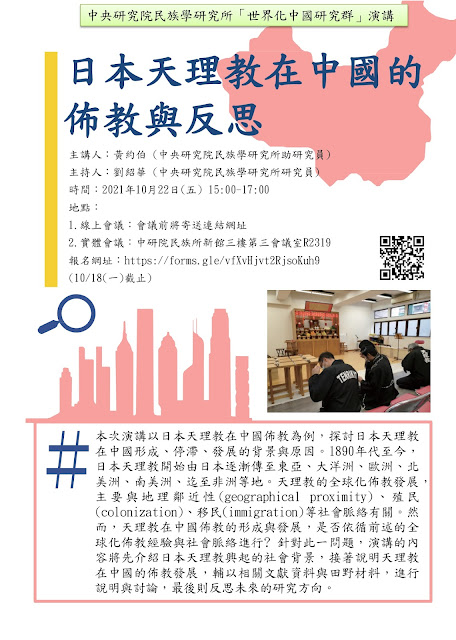
日本天理教在中國的佈教與反思


主講人:黃約伯 (中央研究院民族學研究所助研究員)

主持人:劉紹華 (中央研究院民族學研究所研究員)

主辦單位:中研院民族所「世界化中國研究群」

時間:20211022() 15:00-17:00

地點:

線上會議:會議前將寄送連結網址。

實體會議:中研院民族所新館三樓第三會議室R2319

報名網址:https://forms.gle/vfXvHjvt2RjsoKuh9

報名截止日期:10/18(一)止

(因線上會議系統及實體會議均有人數限制,報名截止後將寄送報名成功信)

會議聯絡Emailgcstudies@gate.sinica.edu.tw

摘要:

本次演講以日本天理教在中國佈教為例,探討日本天理教在中國形成、停滯、發展的背景與原因。1890年代至今,日本天理教開始由日本逐漸傳至東亞、大洋洲、歐洲、北美洲、南美洲、迄至非洲等地。天理教的全球化佈教發展,主要與地理鄰近性(geographical proximity)、殖民(colonization)、移民等(immigration)等社會脈絡有關。然而,天理教在中國佈教的形成與發展,是否依循前述的全球化佈教經驗與社會脈絡進行? 針對此一問題,演講的內容將先介紹日本天理教興起的社會背景,接著說明天理教在中國的佈教發展,輔以相關文獻資料與田野材料,進行說明與討論,最後則反思未來的研究方向。


2021年7月31日 星期六

Ethnicity and Territory Across the Sino-Burmese Border: The Case of the Wa in the Wa Hills


主講人:Naomi Hellmann(納敏)(PhD candidate, University of Utrecht、本所訪問博士生)

主辦單位:中研院民族所「世界化中國研究群」

時間:820日(五)15001700

地點:線上會議,會議前將寄送連結網址

報名網址:https://forms.gle/aCBaNQbUVWppuuou9

(因系統人數限制,有收到信件連結者才表示報名成功)

會議聯絡mailgcstudies@gate.sinica.edu.tw

摘要:

This paper is concerned with cross-border ethnic groups in Sino-Southeast Asia – the area where southwestern China and northern continental Southeast Asia meet. More specifically, my research focuses on the case of the Wa in the Wa Hills – an old civilization that predates the making of modern states. Today, the area is carved up and fixed by territorial subunits with varying degrees of autonomy that traverse the Sino-Burmese border: the Wa Self-Administered Division (Special Region 2) in the northeastern Shan State in Myanmar, and Ximeng Wa Autonomous County, Cangyuan Wa Autonomous County, and Wa ethnic townships in northern Lancang Lahu Autonomous County in southwestern Yunnan Province in China. Ethnically, it is a diverse region with numerous Native highland peoples, who share common characteristics such as language, ancestry, and cultural beliefs that provide the foundation for a nation (ethnic), and of whom the Wa constitute the majority group (75 to 80 percent) with a population of approximately one million people. These so-called cross-border ethnic groups often have potential contradictory implications: they may be seen as both a source of threat and support for nation and state-building efforts. As such, they are simultaneously brought together and yet also kept apart.

The paper is divided into four sections – the first is a consideration of material collected on ethnic groups in China and in Myanmar. The second section provides an overview of Chinese and Burmese ethnopolitics, that is, the state’s mode of administering and governing frontier ethnic minority areas, and China’s territorial expansion and border policies since economic reforms in the 1970s and, in particular, in the three decades since the early 1990s. The third section focuses on the case of the Wa people in the Wa Hills, which is illustrative of the situation that exists across the Sino-Burmese border. Finally, the last section examines in more detail the effects of China’s transformation on cross-border ethnic groups and ethnic autonomous territories both locally and beyond the border. I suggest that, in the case of the Wa, the process of ‘opening up’ has involved a shifting of the border and brought about an increasing asymmetry in relations between the two sides.


2021年7月5日 星期一

在當代中國尋找祖先- 人類學、歷史學與考古學的交會


  • 主講人:王舒俐(中研院民族所助研究員)
  • 主辦單位:中研院民族所「世界化中國研究群」
  • 時間:2021年7月30日(五)15:00-17:00請於7/25前報名 https://forms.gle/iHYVAnyRPzkzbLo99
  • 地點:本演講將以「線上會議」的方式在「Webex」舉行​​
  • 摘要:
        相傳誕生於五千年前的黃帝,被視為中華文明的開創者、中華民族的祖先。在當代中國大陸,改革開放之後各地開始有零星的黃帝崇拜活動,兩千年之後地方政府開始舉辦祭典、修建廟宇、塑立雕像與紀念碑以及各種節慶活動,其中以河南、陝西與浙江最為大規模。筆者自2017年開始在河南與陝西進行田野調查,到河南新鄭G山上採集流傳於當地農民之間的黃帝傳說,並幾度參加各地官方舉辦之黃帝祭典。我在田野過程中發現:這些地方各自引述不同的歷史文獻來佐證其地區與「黃帝文化」的關聯,並透過獎勵地方的考古發掘來佐證,並以文化遺產的登錄加強其合理性與地域建構的論述,有趣的是,這些祭典都已申報為不同層級的官方無形文化遺產。這個演講試圖藉探討當代中國大陸的黃帝熱,闡述全球化的遺產論述的建造(heritage making)、神話製造(myth making)與地域建構(place-making)之過程;其次,我將透過自身之田野經驗來反思學科方法論與界線的不同,如何影響與呈現不同的「歷史真實」。